

Table of Contents
- Before You Start: What Makes a Logic Puzzle Difficult
- How to Solve Logic Grid Puzzles: Reading Clues Like a Detective
- Logic Puzzle Deduction Techniques for Filling the Grid
- Advanced Logic Puzzle Techniques: Hypotheses, Constraints, and Patterns
- Catch Contradictions Early: Error Prevention and Recovery
- Logic Puzzle Practice: Building Skill Through Difficulty Levels
- Reader Resources
- Conclusion
- Frequently Asked Questions
Last Updated: October 16, 2026
Before You Start: What Makes a Logic Puzzle Difficult
Logic puzzles get hard for one reason: the clues stop handing you answers and start handing you relationships. This guide from Jove Publishing walks through tips for solving difficult logic puzzles that hold up when the grid is large and the clues get sneaky.
A logic-grid puzzle is a deduction game built on a one-to-one relationship. Every item in one category matches exactly one item in each other category, and every clue is a constraint that removes possibilities until only the true answer remains.
Difficulty comes from three things:
- Size. Five categories of five items create far more combinations than three categories of four.
- Indirect clues. Clues that describe what is not true, or that link two unknowns to each other.
- Distance between clues. Hard puzzles rarely give you a clue you can act on immediately.
The good news: none of this requires special talent. It requires a system. Below, we break down how to solve logic grid puzzles step by step, from reading the first clue to recovering from a wrong turn.
How to Solve Logic Grid Puzzles: Reading Clues Like a Detective
Reading clues carefully is the single highest-return skill in logic puzzle solving. Most solvers who get stuck did not miss a deduction; they misread a clue. The fix is not to read slower, it is to translate every clue into a specific grid action before you move on.
Train yourself to sort every clue into one of two buckets before you write anything down.
Direct Clues vs. Indirect Clues
A direct clue names a specific item and tells you exactly where it goes or does not go. "The red house is first" is direct. You can mark it immediately and move on.
An indirect clue connects two unknowns. "The doctor lives somewhere to the left of the red house" tells you a relationship, not a location. You cannot place anything yet, but you can eliminate a lot.
A Translation Method for Indirect Clues
Most guides tell you to "read carefully." That is not actionable. Here is a repeatable method that turns any indirect clue into grid marks.
- Identify the two items being compared. Name them out loud: doctor, red house.
- Name the relationship precisely. Left of, right of, before, after, adjacent to, not adjacent to, exactly two spaces from.
- Convert the relationship into position limits. In a five-position row, "doctor is somewhere left of the red house" means the doctor cannot be in position 5, and the red house cannot be in position 1. Mark those two eliminations now.
- Mark the mirrored eliminations. Every position the first item cannot occupy implies a position the second item cannot occupy. Do both sides.
- Re-read the clue for hidden qualifiers. Words like only, not, immediately, and somewhere change the math. "Immediately left of" is a single-position constraint; "somewhere left of" is a range.
Three Worked Translations
Comparative clue: "The violinist performed before the cellist, but not immediately before." In a five-slot program, the violinist cannot be in slot 5, the cellist cannot be in slot 1, and the pair cannot occupy adjacent slots. That last restriction eliminates (1,2), (2,3), (3,4), and (4,5) as violinist/cellist pairings.
Negative clue: "The green house is not next to the blue house." This does not place either house. It removes adjacency, which in a five-position row means if green is in position 3, blue cannot be in 2 or 4. Mark those as conditional eliminations rather than permanent ones.
Multi-part clue: "Of the engineer and the teacher, one lives in the yellow house and the other drives the truck." This is an either/or. You cannot mark either match as confirmed, but you can mark that the engineer does not drive the truck and the teacher does not live in the yellow house. Two eliminations from one sentence.
Logic Puzzle Deduction Techniques for Filling the Grid
The grid is where logic puzzle deduction techniques turn clues into answers. A puzzle grid is a set of small tables, one per category pair, where each cell represents a possible match.
Cozy Christmas & Winter - Crossword Puzzles →
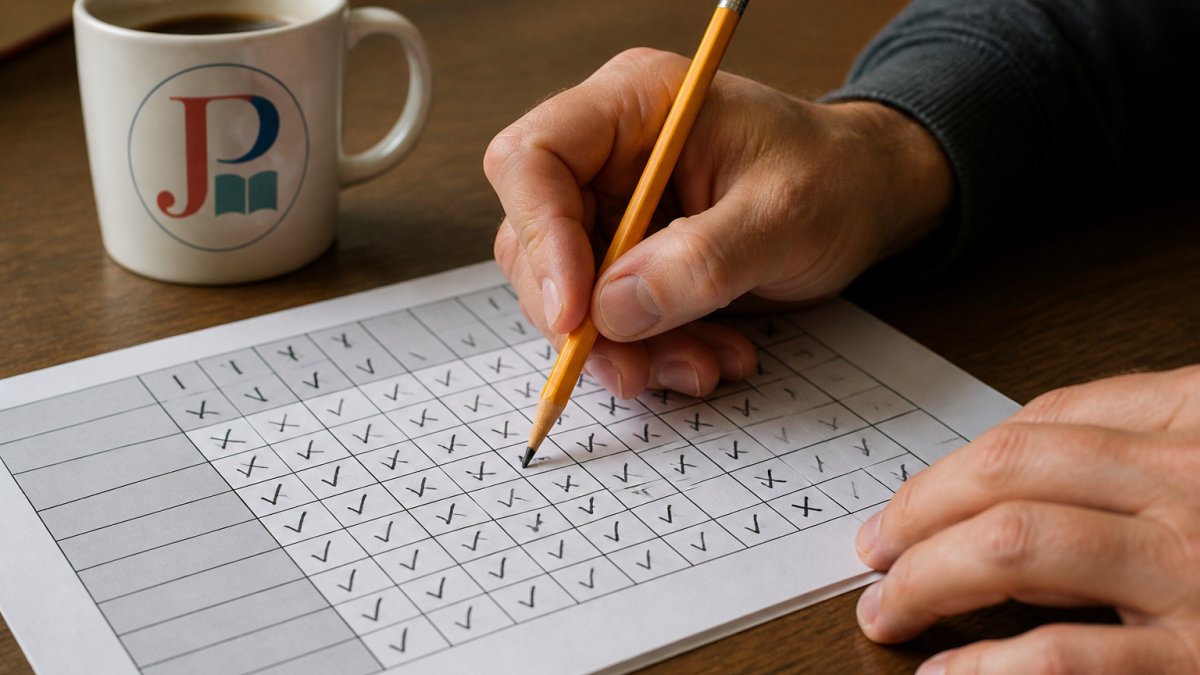
Marking Matches and Non-Matches
Use two distinct marks, and use them consistently:
- A positive mark (checkmark or filled dot) means a match is confirmed.
- A negative mark (X or cross-off) means a match is impossible.
The negative marks do most of the work. In a hard puzzle, you will place far more X marks than checkmarks, and the checkmarks appear once a row or column is exhausted.
Two rules keep the grid honest:
- Every confirmed match eliminates the rest of its row and column. If the red house is first, no other color is first, and the red house is not second through fifth.
- Every row and column holds exactly one checkmark. When a row has one open cell left, it is a match, even if no clue said so directly.
That second rule is the engine of process of elimination. It is also where beginners leave easy wins on the table.
Advanced Logic Puzzle Techniques: Hypotheses, Constraints, and Patterns
When deduction stalls, advanced logic puzzle techniques give you a way forward that is still logical. The key is to separate a hypothesis from a guess.
A guess is random. A hypothesis is a testable assumption with a defined outcome: if it leads to a contradiction, you have proven it false and learned something. If it leads to a full solution, you were right.
When to Use a Hypothesis
Use a hypothesis only when:
- Every direct clue has been exhausted.
- No row or column is down to one open cell.
- You can trace the consequences in a few steps, not twenty.
How to Record and Reverse a Hypothesis
Disciplined branching is what separates a hypothesis from a guess. Follow this sequence:
- Pick the most constrained cell. Choose the open cell with the fewest remaining possibilities. A cell with two options is far better than one with four.
- Mark the assumption distinctly. Use a different color, a circled mark, or a small letter in the corner of the cell. Never use the same mark you use for confirmed facts.
- Write the assumption down. On scratch paper or in a margin, note the cell and the value you are testing. This is your undo point.
- Propagate in one direction. Follow the consequences forward without jumping around the grid. Each new mark should trace directly from the assumption.
- Stop at the first contradiction. A contradiction is a result, not a failure. It proves the assumption false.
- Reverse cleanly. Erase every mark that traced from the assumption, return to your undo point, and mark the opposite value as confirmed.
If the assumption produces a full solution with no contradiction, you were right, but only if every step was forced. If any step required a second assumption, you have not proven anything yet.
Pattern Recognition That Shortens the Work
Watch for these recurring shapes:
- A clue that says two items are adjacent usually pairs with a clue that rules out the ends.
- A clue that says two items are not adjacent often forces a specific middle position.
- When three items must all fall before a fourth, check whether the fourth can only sit in one or two slots.
- When two clues share an item, chain them. If A is left of B and B is left of C, then A is left of C, and you can mark that directly.
How Constraints Compound
Constraints compound. Each new confirmed match shrinks the space for every remaining item, which is why hard puzzles often crack open suddenly after a long quiet stretch. A single confirmed match in a five-category puzzle can eliminate dozens of cells across multiple grids at once.
Catch Contradictions Early: Error Prevention and Recovery
Contradictions are the most common reason solvers abandon a puzzle. A contradiction means two confirmed facts cannot both be true, and it almost always traces back to a mark placed too fast.
Prevent them with a consistency check after every few deductions:
Cozy Christmas & Winter - Crossword Puzzles →
- Does any row or column have two checkmarks? That is an error.
- Does any row or column have zero open cells and no checkmark? Also an error.
- Did a new match eliminate a cell you had already confirmed?
| Problem | Likely Cause | Fix |
|---|---|---|
| Two checkmarks in one row | A mark placed without clearing the row | Erase one, recheck the clue |
| Puzzle stalls with no moves | An indirect clue misread | Re-read every clue with "not" in it |
| Solution conflicts at the end | An early assumption treated as fact | Backtrack to the last certain mark |
| Grid fills but answer is wrong | A negative mark used as a positive | Rebuild the affected category |
Recovery is straightforward once you find the bad mark. Work backward to the last deduction you were certain about, erase everything after it, and restart from there. It costs a few minutes. Starting over from scratch costs far more.
Logic Puzzle Practice: Building Skill Through Difficulty Levels
Logic puzzle practice works best when you climb difficulty on purpose rather than jumping to the hardest book on the shelf. Skill builds through repetition at a level you can finish.
A practical progression:
- Start with three categories and four items. Focus on clean marking habits.
- Move to four categories. Indirect clues appear here for the first time.
- Add a fifth category. Now you need hypotheses, not just elimination.
- Try themed puzzle books. Familiar subjects make long clue chains easier to hold in your head.
Track what slows you down. If you lose time re-reading clues, your marking system needs work. If you lose time staring at a stalled grid, your hypothesis technique needs work. Those are different problems with different fixes.
Reader Resources
Puzzle fans who want more grids to practice on can browse the puzzle and activity books from Misty Clover Press at mistycloverpress.com. The catalog includes crossword collections and themed puzzle books built for adults who want a real screen break.
Readers can also claim a FREE Printable Activity Sampler by Misty Clover Press at this link, and explore more free reader resources at the Jove Publishing shop.
Conclusion
Every difficult logic puzzle is solvable with the same handful of habits: read clues twice, mark negatives as carefully as positives, and treat every hypothesis as a test rather than a belief. The grid rewards patience far more than speed.
At Jove Publishing, we publish puzzle and activity books from Misty Clover Press, including crossword collections with clearly marked difficulty levels and complete answer keys. Visit the Jove Publishing store to continue shopping and find your next puzzle.
Frequently Asked Questions
How do you solve a logic grid puzzle step by step?
Start by reading every clue before writing anything. Fill in direct clues first, then mark non-matches with X marks. Use process of elimination to cross off false possibilities and confirm matches. As the grid fills, look for patterns and constraints that link categories. Work systematically rather than guessing, and check each deduction against the original clues. If you get stuck, revisit indirect clues you may have skipped.
When should you make an assumption in a logic puzzle?
Only use a hypothesis when every direct deduction is exhausted and the grid still has gaps. Pick the option with the fewest remaining possibilities, assume it is true, and follow the chain of deductions. If you hit a contradiction, that assumption is false, so cross it off and try the alternative. This trial-and-error method works best on advanced logic puzzle techniques, not beginner grids.
How can you avoid mistakes when solving a logic puzzle?
Read each clue carefully and note exactly what it says, including negative statements. Mark every deduction in the grid immediately so you do not rely on memory. Work slowly and check each new mark against existing ones for consistency. If two marks conflict, stop and trace back to find the error before continuing. Keeping your grid tidy makes contradictions easier to spot.
What should you do when you get stuck on a logic puzzle?
Take a short break and return with fresh eyes. Re-read every clue, especially indirect ones you may have overlooked. Check whether you missed a negative clue or a comparison that limits options. Try working from a different category or use a hypothesis on the most constrained item. Logic puzzle practice with varied difficulty levels builds the pattern recognition that helps you push through stuck points.